

Safety in Connection

Up until now, I thought I knew what a “safe space” was. But it wasn’t until my conversation with my son this morning that I finally understood what it truly means to “hold space” or “create safety” for someone.There are many theories of the mind that solely focus on thoughts and how they affect emotions, behaviors, etc. But when we think about emotions, behavior, and even thought, I think we forget (or we just don’t know) about the connection all of that has to the body’s nervous system. And if you don’t know me by now, just know that I am completely obsessed with the nervous system (find out more about that here). Knowing about the health of our nervous system is perhaps the most important aspect to know when thinking about healthy thoughts, emotions, behaviors as well as our interactions with others. So let’s look into it on a very basic, yet understanding level.
The Nervous System (NS) and Polyvagal Theory: An Introduction
The nervous system is a network of nerves & the command center of the brain and body. It sends electrical signals throughout your body which controls everything you do, not just your thinking or feeling. Some of the other function influenced by the nervous system are:
memory and learning
movements, such as balance and coordination.
senses, including how your brain interprets what you see, hear, taste, touch and feel
sleep, healing and aging.
heartbeat and breathing patterns
response to stressful situations
digestion, as well as the hormones associated with how hungry and thirsty you feel
body processes, such as puberty
Our nervous system is how we communicate the outer world to our inner world and vice versa!
Complex System Made Simple-ish
There’s two main parts of the NS, each incharge of their own extra special tasks. The two main parts are:
Central Nervous System (CNS): this consists of your brain and spinal cord
Peripheral Nervous System (PNS): this consists of lots of nerves that extend from the spinal chord to other parts of the body such as the organs, arms, legs, fingers, and toes.
Within the PNS, there are two other subgroup of nerves that serve specific functions. They are the:
Somatic Nervous System: incharge of voluntary movement that we have conscious control over such as walking.
Autonomic Nervous System (ANS): incharge of involuntary movement that the body does on it’s own such as breathing and digesting.
Within the ANS, there are yet another subgroup of nerves that serve a different yet specific function. They are:
Sympathetic Nervous System (SNS): this part of the autonomic system is incharge of activating us in the event of emotionally heightened events, otherwise known as the fight or flight response. When our bodies need the energy to defend itself, it will pull resources from everywhere to do so.
Parasympathetic Nervous System (PNS): this part of the ANS returns the body back to homeostasis after the danger has left, otherwise known as the rest and digest response. But it also puts the body into a freeze when the body thinks its in life threatening situations. Think about dissociating during traumatizing times —that’s what this freeze response looks like.
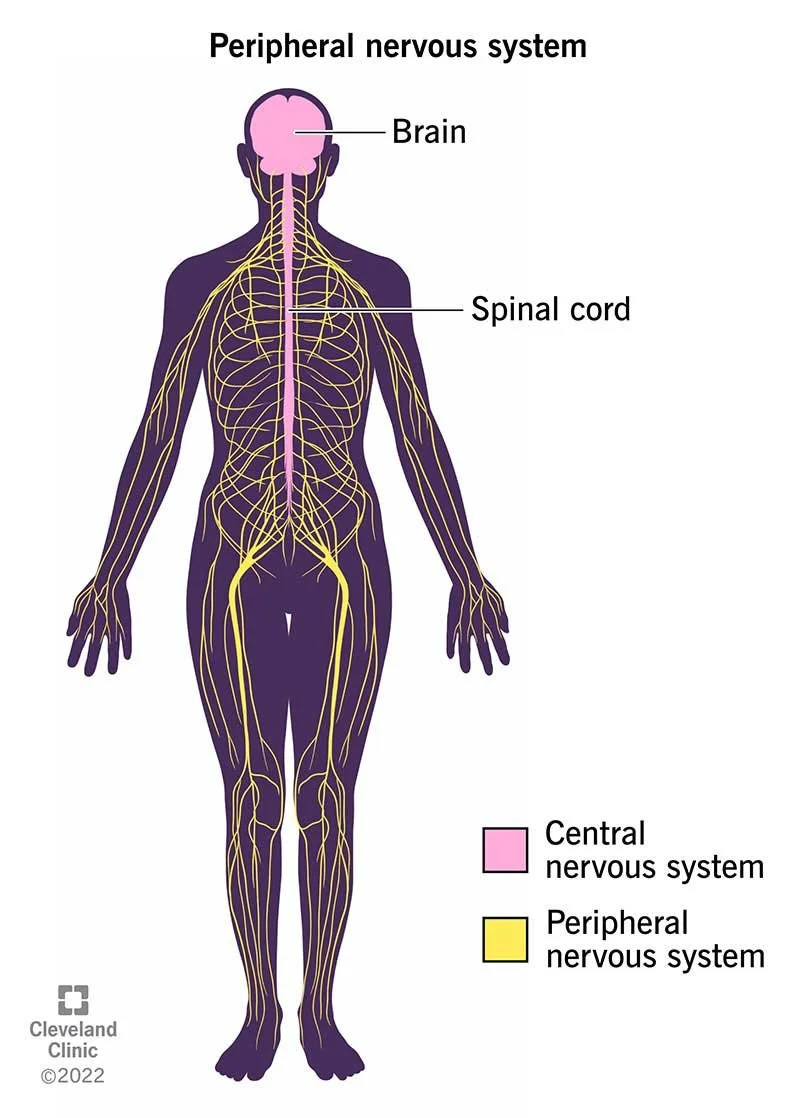
For a better understanding of what the Nervous System looks like in its basis form, please refer to the pictureabove. The pink area is the Central Nervous System while the yellow areas are the Peripheral Nervous System. Source Info.
How We Get to the Polyvagal Theory
Now, how does any of this relate to safety, connection, and how we relate to others? Well, within the Autonamic Nervous System, there is a nerve called the Vagus Nerve, that runs from the brainstem all the way to our colon and is the longest nerve within that system. So when we’re talking about mind-body connection, the Vagus Nerve is the reason that exists.
The Polyvagal Theory (PVT) was created by Dr. Stephen Porges in 1994 and it emphasizes the role the autonomic nervous system - especially the vagus nerve - plays in regulating our health and behavior as well as our overall day-to-day interactions.
There are 3 Key principles of the Polyvagal Theory and they are:
The Hierarchy of the Autonomic Nervous System: the body will shift to match the level of safety it perceives to be in at any given moment, whether we’re aware of it or not.
Neuroception: the nervous system is always scanning and always sending information back & forth between the neurons within the NS and the rest of the body. Information is gathered from the body, other people, and the environment we’re in.
Co-regulation: we are always sending signals to others, whether knowing or unknowing, that tell them what level of safety we’re feeling as well as what level of safety they should feel with us.
If you don’t get anything from that section, understand this: how your body intakes information from the outside world will determine how your internal world reacts to it. So whether your nervous system thinks you’re in danger, you’re safe, or you’re in a life threatening situation, it’ll be right 100% of the time and will respond accordingly…UNLESS we learn about the process and learns ways to help ourselves return to homeostasis.
(*to get more in-depth information about Polyvagal Theory and/or Dr. Stephen Porges, please visit here and here, respectively*)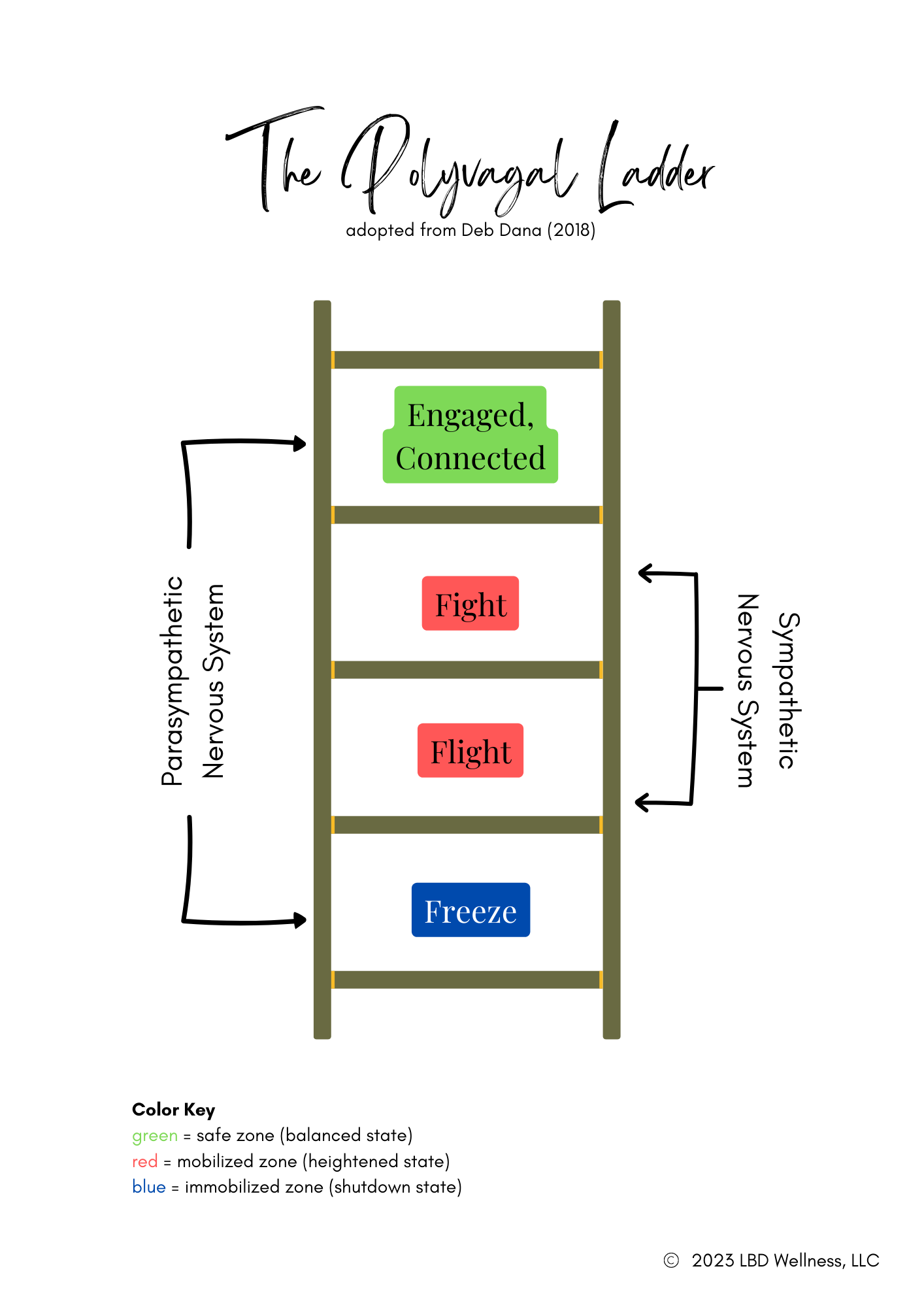
The Polyvagal Ladder created by Deb Dana demonstrates how the hierarchy of the Autonomic Nervous System works as well as what kind of engagement you will get/put off during each state.
Keep in mind that hybrid states do occur and more information/context would need to be present in order to determine which state the body is in.
Polyvagal Theory, Co-Regulation & Reparenting
When we combine all of that, what it means is that our body assesses safety on its own but uses what we have been taught by others and the world around us to form the foundation for those associations of safety, danger, and life threatening situations. When we put that information in the context of providing safe environment for our children, what does that mean? That we are helping teach their nervous systems whether they are safe, in danger, or in a life threatening situation.
So what’s the key here? The key is safety. Through this theory as well as my clinical and personal experiences, I have learned that co-regulation must come before self-regulation in order to create a sense of safety.
Read that again:Co-regulation must come before self-regulation in order to create a sense of safety.
But it’s not just having someone teach you how to handle a situation and/or emotion. It actually involves your neuroception signaling to your body, “you are safe, this is safe, they are safe”. Your nervous system must first feel safe in order to know how to cultivate a safe space for future reference. Through co-regulation, someone else (usually our parents or caretakers during childhood) is able to model, not just to us but also communicate to our nervous systems, “this is what calm and safe looks and feels like, you are safe here”.
So going back to the conversation I had with my son this morning . For reference: My son has ADHD and we are currently navigating ways to keep his self-esteem high while accommodating his brain type and learning that most schools aren’t so kind to those that fall outside the lines of “normal” or “behaved”. He was telling me about his ADHD and how he wishes he didn’t have it because then maybe his teachers would be nice to him. As a mama, you know my heart dropped and was immediately angry at these teachers! Had this conversation happened 5 years ago, I probably would’ve responded with “don’t say that! You’re a great kid and don’t let these teachers make you think otherwise!” And although that wouldn’t have been a terrible respoense, it also wouldn’t have gotten to the root of the issue in that moment. After hearing him say that and process the fact that he was extremely sad about being different, it made me very sad for him as well. With the few seconds that it took for me to tap into the emotion of the moment, I realized with my neuroception that my child was experiencing sadness and feeling different and even if I told him not to feel that way or that his teachers were wrong in some way, it wouldn’t have acknowledged or validated what he was feeling in that moment. So with tears in my eyes I sad, “You’re so sad that your teachers seem to treat you differently than they do other people and I can’t hear how sad that makes you.” I looked back while saying this and noticed that his gaze had softened a bit and it immediately invited him to tell me more about his experience but also some people that he felt good around and who didn’t make him feel different. I added all the mama affirmations at the end of the conversation (“You are loved, you are special, and you are cared for, etc”) but felt so much joy with knowing that he knew his emotions were safe with me.
Your Own History of Safety
As adults, when we’re faced with having to hold space for our children when they have BIG emotions, we may find that instead of empathy or connection, we go into survival mode, signaling to us that there is DANGER. Believe me when I say that I was there not too long ago so I know how guilty the feelings can leave you.
Why is that? Because we don’t have an internal point of reference of what it looks like for an adult to hold space for a child. If you’ve never had someone energetically show you what safety looks and feels like, your brain and body will not know how to take you there in times of stress or how to provide it for others. The system needs a point-of-reference.
Oh no, I don’t know what to do.
Panic sets in, disguised as anger, irritation, etc. All you’ve communicated to your child is, “I’m not a safe person and your needs can’t be met here”. When this happens repeatedly, your child starts to learn that their emotions cause big reactions from their grown-up and will learn to minimize their needs to lessen that big reaction. All they learn is that their emotions are not safe with their grown-ups. I’m sure that if you look at your own history, you’ll find that you learned the same story about your grown-ups at the time. I’m sure there is a moment or a couple of moments that you can think of when you tried to go to your parent or caregiver about an emotional issue and ended up feeling even worse after telling them, on top of now feeling miserably alone. Although we might feel bad about doing it now, the reality is that most of the time, we’re only doing what was taught to us. If we were consistently told or taught to shove out emotions down or that emotions were bad, then the only reasonably way for you to deal with emotions as an adult, whether they’re yours or someone else’s, is to teach them the same. Unfortunately, this is how the cycle continues. But fortunately, acknowledging this cycle and putting in the work to actively cultivate a sense of safety in your body and your relationships with others is how the cycle is broken.
Cultivating Safety
It is our responsibility as the grown-ups to learn how to cultivate a safe space for our own vulnerabilities before we can provide one for anyone else, especially our children & families. Even if we don’t have point-of-references from childhood, we can model to ourselves what it would’ve looked like and be that for ourselves now. We must find people, places, and activities that cultivate the feeling of safety and connection so that our cups are full enough to give some to our children, if and when they need it. And as we all know, regardless of whether your children are big or little, they will always need it.
Tip: If you’re like me, and need real-life, tangible examples, try to find healthy examples in your friendships, partnerships, etc. One of my biggest role models were the parents of one of my ex-boyfriends from high school! So when I say look for examples, I mean really dig! If you don’t have any in your life, do a Google, IG, Pinterest, YouTube, whatever! And search. All solutions are valid here.When I look back at the conversation from this morning, I really think about the fact that the emotional connection that was had between my son & I in that moment started with me regulating myself FIRST and then empathizing & validating the experience that was being brought to me, not the one I thought he should be having. Had I not regulated myself and cultivated safety in that moment, I would’ve responded from a threatened place, not a safe place and he would’ve never felt safe enough to be vulnerable with me about his experience. That brought a sense of pride because I know how long it’s taken me to get to this point. My child is almost 10 and it took almost the entirety of that time to cultivate a sense of safety in my body and in my relationship with him (more information about why here). So mama, if you’re thinking that you can’t turn your relationship with your children around just because “they’re too old”, think again. It’s never too late to repair relationships and mend connections.
Our gift to our children is providing them with that same feeling of safety and connection in all that we do so that when the time comes, and they’ve grown into their own young adults, that feeling still remains when coming to us — that feeling of coming home.
If you’re needing additional help tapping into those deeper emotions and creating an internal sense of safety for yourself, contact me to schedule your free consultation today!
For more information about the service type offered, click here!